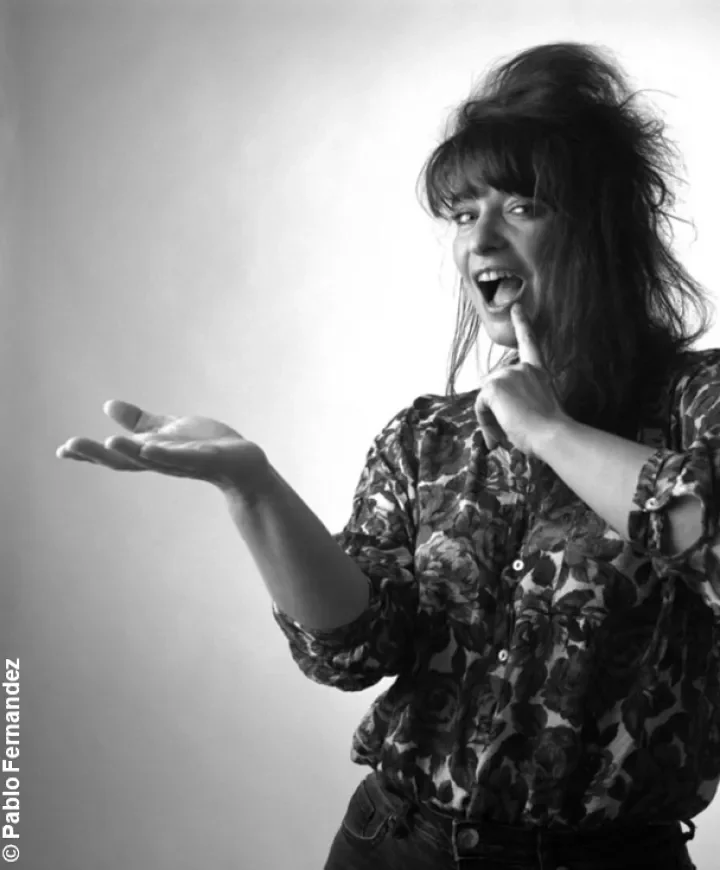
Julie Cavalli, between singing and teaching
Can you briefly introduce yourself — where you come from and what led you to music?
I've always sung, for as long as I can remember. As a child, I sang in my room, at family parties, in choirs. At 14, after seven years of violin at the conservatory, I decided to dedicate myself to singing. At the time, classical (opera) singing was the only option on offer, but that suited me well since I'd grown up in a family where classical music was also very present.
I started with a singing teacher in La Chaux-de-Fonds, whom I studied with for about ten years. Around 18-20, the idea of making it my profession became fairly obvious, even though my academic background was far from ideal: I'd had little training in theory, and the professional world seemed hard to break into. I was flatly advised to train for another profession on the side. So I did an apprenticeship as a florist, then trained as a home-care aide, all while continuing to sing.
What kind of training did you pursue? What were your studies like?
At 29, shortly after my daughter was born, I decided to try the entrance exam for the HEM, at the Neuchâtel campus. I thought I had little chance of being accepted, especially because of my age and my gaps in theory, but my future teacher, Jeanne Roth, never doubted me. I passed the exam and started a Bachelor's degree. It took an enormous amount of work, especially in theory, but I managed to see it through, then went straight on to a Master's in concert performance, which I finished in 2015. Looking back, I might have chosen a Master's in pedagogy instead, but at the time I mainly wanted to sing and focus on performance practice.
Where are you in your career today? What does your daily life as an artist look like?
Since my studies I've worked on various projects, notably with the choir of the Opéra de Lausanne, while also developing my teaching activities and personal projects. In 2026, I was finally given a 60% tenured position at the Lausanne Conservatory, where I teach musical theatre. My ideal balance would have been 60% artistic projects and 40% teaching. In reality, it's more the reverse — roughly 70% teaching and 30% artistic projects. Teaching therefore takes up a large part of my year, while my artistic projects tend to come in bursts. This means I work on my vocal technique a little less consistently when I don't have an upcoming project. That's not necessarily ideal, but it also gives me a chance to breathe, since vocal work can be very intense. When I do have a project, on the other hand, I get seriously down to work. I like functioning that way, with concrete goals.
Looking back, what key elements have helped you in your professional life?
I remain very grateful to certain teachers at the Neuchâtel music school (HEM). My path wasn't easy, and I doubted my ability to make it right up to the end. Some people would regularly remind me that I was "too old," so naturally, the encouragement from those who noticed my efforts mattered a great deal — it gave me confidence in myself. When I entered the Bachelor's program, I was starting with enormous gaps. By the end of my Master's, I got a 5.9 on my recital and a merit scholarship. It was a real point of pride: I told myself I'd come a long way.
My studies also gave me a network, friendships, and professional connections that still last today. Chamber music classes, summer projects, and stage experiences also let me discover new repertoire and nourished me artistically.
And looking back, I realize how lucky I was to study in Neuchâtel. The working conditions were truly exceptional: beautiful halls, a pleasant building, easy access to practice spaces, and a small community. It was an environment that made it possible to work hard and build close relationships.
Is there anything you wish you had known when you finished your studies?
I think we were often reminded that there was only one path: that of the great soloist, following a very specific academic track. There wasn't enough talk about other possibilities — working in choirs, self-producing, juggling multiple projects, teaching, or building a more hybrid artistic career. My singing teacher always told me there was room for everyone in singing and that many different paths existed. I wish that vision had been given more space in the academic world.
Academic training can also feel a bit disconnected from professional reality. In my case, my age and maturity ultimately helped me keep things in perspective. But my first years of the Bachelor's were so demanding — between theory, vocal work, and life as a young mother — that I had practically no room to build up any professional activity on the side. I started working more as a singer during my Master's.
To end on a really lovely note.
When you start your studies, you don't know how they'll turn out, or even whether you'll finish them. But what's rather amazing in my life today is that, on top of what I already had when I started — a life, a child, friends — I've also kept many true and dear friends I met during my studies. And we still work together, we do projects together. In a way, it was unlikely, and that too is beautiful!
Today, with my position at the Lausanne Conservatory, my teaching activities, and my artistic projects, I tell myself my path hasn't turned out so badly after all. I never dreamed of singing at La Scala or becoming a great international soloist. What I wanted was simply to make a living from music. And in the end, that's exactly what I'm doing.
See more about the diplomas
Bachelor of Arts in music Master of Arts in Music Performance