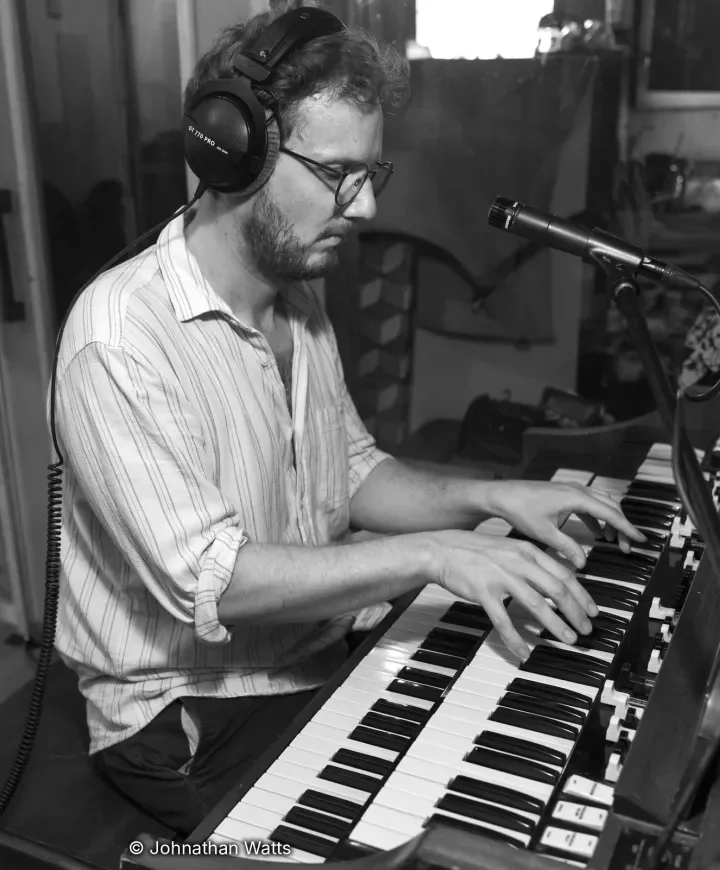
Mathias Liengme, from ethnomusicology to production
Can you briefly introduce yourself — where you come from and what led you to music?
I’ve lived in Geneva since I was 10 and did all my schooling there. I started out in music with classical piano training at the Conservatoire populaire de Genève, then moved on to jazz. At 13, I formed my first band with friends from that time: a reggae band. That’s how I discovered this music, first in Geneva and in Switzerland, then in Jamaica. I was lucky enough to spend time with great Jamaican musicians passing through Geneva, notably the drummer Leroy “Horsemouth” Wallace. I toured Switzerland and Europe with him, and later went to live at his place in Jamaica. I was 19, and it was my first time there.
Today I’m a musician, but above all a record producer, both on the business and the artistic side. I handle the entire production chain for recordings: from creating the music in the studio through to distribution, marketing and sales. In short, I take it all the way to the moment the music reaches the listener’s ears.
What kind of training did you pursue? What were your studies like?
I first studied humanities, earning a bachelor’s degree in French literature and the history of religions. That was when I took my first musicology classes, as an auditor. I already had a busy musical life alongside my studies, touring and playing in lots of bands. I realised it would make more sense for me to continue my studies in a field related to music. This coincided with the launch of the joint Geneva–Neuchâtel master’s in ethnomusicology, the perfect opportunity to bring together my practice, my passion and the next step in my academic path.
Since I came from neither musicology nor anthropology, I had a lot of catching up to do alongside the master’s. It was a heavy workload, but I finished it in three years. Above all, the master’s allowed me to build connections and meet institutional partners I went on to work with, notably at the Musée d’ethnographie de Genève (MEG). That’s where I discovered the museum’s sound archives, which I have worked on with Madeleine Leclair in recent years.
The HEM introduced me to non-European musical practices, or at least gave me a good overview of them. I also took classes with Fabrice Contri and Xavier Bouvier, which were very interesting. The master’s gave me grounding in the history of the discipline and in fieldwork, as well as a scientific foundation. It gave academic depth to something I was already doing and broadened my perspective.
I was enrolled at the University of Geneva, but the classes were split roughly into thirds between the HEM, the University of Neuchâtel and the University of Geneva, with a few at the MEG. So it was spread across many locations and, to be honest, a bit tedious at the time, though I think it has improved a lot since then. It was only the second intake of the programme, and there were just three of us in my year. That meant we had very close contact with our professors, some of whom I still see today. It was a really great part of those studies.
Where are you in your career today? What does your daily life as an artist look like?
Over the last few years, I’ve done a range of things, including exhibitions at the MEG such as “Afrosonica – Paysages sonores”. But these days, it’s mostly the label “Fruits Records” that keeps me busy: producing records, organising concerts… And there’s all the administrative work that comes with it. The truth is that these days I’m more of an administrator than a musician. You have to raise funds to get these kinds of projects off the ground and handle all the follow-up, which is essential to the day-to-day running of a record label. Of course, I also work in a recording studio where the music gets made. So there’s a creative side too: composition, arrangement, artistic direction, choosing who to work with. But I’ve somewhat traded my creator’s hat for an administrator’s one.
Do you miss that, or do you actually enjoy it?
Handling the admin side isn’t a problem for me; I actually rather enjoy it. The flip side is that I don’t practise my instrument as much. My artistic practice suffers from the time spent on everything “peripheral”, everything that surrounds the art itself. It’s a bit of a shame, but that’s the reality of being a musician in independent, original music: you need a lot of admin to be able to do a little art.
Looking back, what key elements have helped you in your professional life?
To be honest, my day-to-day work has moved a long way from my field of study. But in practical terms, the reason I worked at the Musée d’ethnographie after my studies is clearly this master’s, and meeting Madeleine Leclair, with whom I did an internship as part of the programme. A few years later, that internship led to a job. Working within a large institution taught me a lot about the working world, and that experience has definitely shaped how I work today.
All in all, I’m happy with my path. My work depends largely on the funding we manage to secure, so there’s always some uncertainty, but it allows me to do what I love: producing music and bringing it to an audience. This master’s was an important step along the way, and what I value most from it are the connections and collaborations it helped me build.
Is there anything you wish you had known when you finished your studies?
These days, people expect higher education to lead to a guaranteed job, even though it doesn’t always prepare you directly for one. There is a certain gap between academic programmes and the realities of the job market, but it would be unfair and simplistic to blame the studies themselves.
Apart from that, the master’s in ethnomusicology was still young and had modest resources. There was no dedicated chair: the students were spread across three institutions, and none of them had enough to justify one. As a result, the opportunities to pursue an academic career, whether through a PhD, an assistantship or SNSF funding, were very limited. That’s probably the path I would have taken if the opportunity had arisen, and I know it’s a development the professors very much hope to see. It would be a great prospect for the programme.
See more about the diplomas
Master in Ethnomusicology